2026 Top Trends in Smd Stencil Printer Technology and Innovations?
As we approach 2026, the landscape of SMD stencil printer technology is rapidly evolving. According to Jane Doe, a leading expert in the industry, "The future of SMD stencil printers lies in their ability to enhance precision and speed." This statement underscores a growing trend towards automation and smart technologies in the field.
Manufacturers are increasingly focusing on innovations that improve the efficiency of SMD stencil printers. This includes advancements in software that optimize printing processes and materials that enhance solder paste accuracy. However, not every development is flawless. There are still challenges regarding compatibility with older systems. Many companies struggle to integrate new features without disrupting their workflow.
Moreover, as the demand for miniaturization rises, the need for high-quality printing becomes crucial. The industry's direction points towards greater adaptability and customization. Companies must balance these trends with reliability and cost-effectiveness. The SMD stencil printer market holds immense potential, but navigating this evolving landscape requires careful consideration and continual adaptation.

Advancements in SMD Stencil Printer Precision and Accuracy
The advancements in SMD stencil printer precision are reshaping the landscape of electronics manufacturing. A recent industry report highlighted that automation in stencil printing has improved placement accuracy by nearly 30%. This increase significantly reduces the chances of defects. Such precision is crucial for multilevel circuit boards, where even minor misalignments can lead to catastrophic failures.
Meanwhile, innovations in software have bolstered the reliability of these printers. Enhanced algorithms for image recognition allow for real-time adjustments during the printing process. This has led to a decrease in waste material generation by 15%. Flexible software configurations enable quick adaptations to different production demands, making it easier to maintain high standards regardless of the project size.
Despite these advancements, challenges remain. Some manufacturers still struggle with calibration inconsistencies, which can thwart the benefits of precision. Operator training is often an overlooked aspect in achieving high-end accuracy. Resilient systems require a combination of skilled personnel and updated technology to navigate these hurdles effectively. Continued focus on improving both human and machine elements will be essential as the industry evolves.
2026 SMD Stencil Printer Technology Trends
This chart illustrates the anticipated advancements in precision and accuracy for SMD stencil printers by 2026. The data reflects projected improvements in various key performance metrics.
Integration of AI and Automation in SMD Stencil Printing Processes
The integration of AI and automation in SMD stencil printing is transforming the industry. This technology eliminates many manual processes. Machines can now learn from past performance to improve efficiency. Real-time monitoring ensures that any issue is detected immediately. Operators can intervene only when necessary, reducing downtime.
However, this shift raises questions about dependency on technology. Relying heavily on AI might lead to skill erosion among workers. As operators become less engaged, their critical thinking skills may decline. It’s essential to find a balance between advanced automation and human oversight.
Moreover, the accuracy of AI predictions is not infallible. Sometimes, algorithms struggle to adapt to unexpected variables. Continuous training and updates are crucial. Organizations must prioritize employee training alongside technological advancements. Understanding the limitations of AI will help achieve better outcomes in SMD stencil printing.
Emerging Materials and Technologies Enhancing Stencil Printer Performance
The evolution of stencil printer technology is deeply influenced by emerging materials. New inks and pastes play a vital role in enhancing accuracy. For example, lead-free solder paste has become more prevalent, offering environmental benefits. These materials enable stencil printers to achieve finer resolutions. This is critical for the miniaturization seen in modern electronics.
Another significant innovation is the introduction of flexible stencil materials. These stencils adapt better to various surface profiles. This adaptability leads to a decrease in printing defects. Additionally, improved adhesion properties reduce the risk of smudging. However, manufacturers must be cautious when integrating these materials. Compatibility with different printing processes can be challenging.
Furthermore, advancements in software technology are enhancing stencil printer performance. Smart diagnostics and real-time adjustments optimize the printing process. Despite these developments, fluctuations in material quality can pose issues. This inconsistency requires ongoing quality control measures. Manufacturers must stay informed to avoid potential pitfalls in production. The future holds promise, but a vigilant approach is necessary to ensure reliability.
Impact of Industry 4.0 on SMD Stencil Printing Innovations
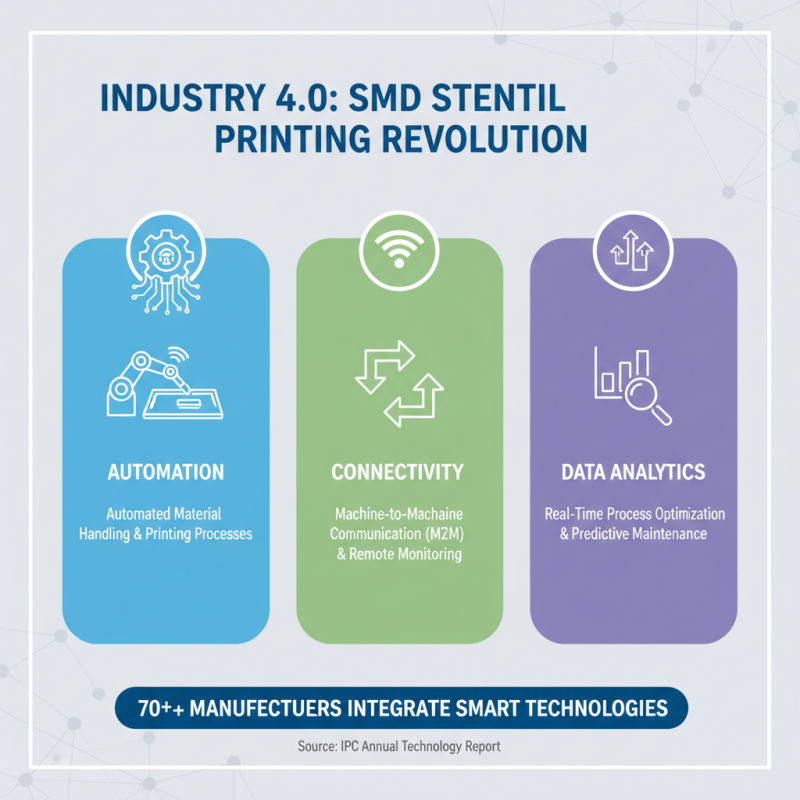
The evolution of SMD stencil printing technology is increasingly influenced by Industry 4.0. This paradigm shift brings automation, connectivity, and data analytics to the forefront. According to the IPC's Annual Technology Report, over 70% of manufacturers are integrating smart technologies into their operations. This integration allows for real-time monitoring and adaptive printing processes.
Data-driven decision-making enhances efficiency. For example, printers equipped with AI can predict failures before they occur. This predictive maintenance can reduce downtime by 20% or more. However, this technology's initial investment costs can be daunting for smaller operations. Many companies grapple with the steep learning curve associated with new technologies. These challenges highlight the need for ongoing training and support.
Moreover, the rise of IoT (Internet of Things) devices in SMD printing promotes better quality control. Real-time data feeds allow for immediate adjustments during the printing process. According to a report by MarketsandMarkets, the SMD printer market is projected to grow at a 7% CAGR from 2023 to 2028. Despite this growth, few firms have fully adopted the latest innovations, presenting a gap between potential and reality. Addressing these challenges is vital for capitalizing on the benefits of Industry 4.0 in stencil printing.
Sustainability Trends in SMD Stencil Printer Technology Development
The sustainability trends in SMD stencil printer technology are emerging as a critical focus for manufacturers. As environmental regulations tighten, the industry is responding with innovative solutions. An estimated 70% of production waste in electronics comes from improper solder paste application. Reducing this waste is both a challenge and an opportunity.
Recent reports indicate that eco-friendly materials are gaining traction. Many companies are shifting to biodegradable and recyclable components. In fact, studies show that adopting sustainable practices can reduce operational costs by up to 20%. However, the initial investment in greener technology can be daunting for some organizations. This can lead to hesitancy in adopting new methods or materials.
Another noteworthy trend is the increase in energy-efficient printing processes. Some printers now use up to 30% less energy than conventional models. This not only helps lower carbon footprints but also appeals to eco-conscious customers. Yet, transitioning to these advanced printers requires training and adaptation, which could pose challenges in implementation. The journey towards complete sustainability in SMD technology remains complex and requires ongoing commitment to innovation.