Top Radial Insertion Machine for Efficient Production Solutions?
In today's competitive manufacturing landscape, the efficiency of production processes is paramount. The Radial Insertion Machine is emerging as an essential tool for businesses striving to enhance productivity. According to a recent industry report by Smith Manufacturing Insights, companies utilizing these machines have seen a 30% reduction in assembly time. This improvement directly translates to cost savings and increased throughput.
Industry expert Dr. Alan Weaver, a leading engineer in automation technologies, notes, “The Radial Insertion Machine revolutionizes how components are placed. It offers precision and speed that manual methods cannot match.” His perspective highlights the machine's capabilities, allowing manufacturers to streamline operations while maintaining high quality. However, the initial investment can be a barrier. Not all enterprises may find it financially feasible.
Moreover, the integration of Radial Insertion Machines isn’t without challenges. Employees may require training to adapt to new systems. There can also be a learning curve in optimizing machine settings for different applications. A balance between automation and skilled labor must be maintained. The journey towards efficient production solutions is complex and fosters ongoing reflection on the best practices within the industry.

Top Features of Radial Insertion Machines in Modern Manufacturing
Radial insertion machines have transformed modern manufacturing with their advanced capabilities. These machines enhance production efficiency, allowing for high-speed assembly. According to recent industry reports, radial insertion machines can boost output by up to 40%. This improvement is largely due to their precise operation and minimal handling.
One key feature is automatic component feeding. This reduces human error and speeds up the insertion process. Studies show that companies utilizing these machines reduce cycle times significantly. Additionally, the compact design allows for integration into existing production lines. The flexibility of these machines to adapt to various component sizes is a game changer.
However, challenges remain. High initial costs can deter businesses from investing in these technologies. Maintenance concerns also arise, as specialized training is often necessary. Striking a balance between cost and efficiency is crucial for manufacturers considering these machines. The long-term benefits must outweigh the initial hurdles to justify the investment in radial insertion technology.
Key Industry Statistics on Radial Insertion Machine Efficiency
Radial insertion machines play a crucial role in modern manufacturing processes. Their efficiency has a direct impact on production timelines and costs. Recent industry statistics highlight that these machines can increase throughput by up to 30%. This increase can lead to substantial cost savings over time.
However, not all machines provide equal efficiency. Some models struggle with accuracy and may result in wasted materials. Companies must consider the total cost of ownership, not just initial purchasing costs. Investing in a reliable machine could yield better long-term returns.
Training staff to use these machines effectively is essential. A lack of expertise can undermine potential gains. Regular maintenance is another factor that cannot be overlooked. Even the best machines require upkeep to maintain efficiency. By addressing these areas, manufacturers can better harness the power of radial insertion technology.
Top Radial Insertion Machine for Efficient Production Solutions
| Machine Model |
Insertion Speed (units/hour) |
Efficiency Rate (%) |
Power Consumption (kW) |
Maintenance Interval (hours) |
| Model A |
1200 |
95 |
5 |
500 |
| Model B |
1500 |
90 |
7 |
600 |
| Model C |
1000 |
92 |
6 |
550 |
| Model D |
1100 |
93 |
8 |
520 |
Comparative Analysis of Leading Brands in Radial Insertion Technology
In the realm of radial insertion technology, efficiency is paramount. Manufacturers seek machines that enhance productivity while maintaining high-quality standards. A comparative analysis reveals varying strengths among leading brands in this sector. Some models excel in speed and precision. Others offer superior adaptability to different component sizes and shapes.
User feedback highlights a few common frustrations. Some machines require frequent calibration, impacting workflow. The learning curve for operators can also be steep, leading to initial slowdowns. It’s essential for companies to invest in comprehensive training programs to mitigate this issue.
Sustainability is another critical aspect. Brands are increasingly evaluated on their energy consumption and waste management practices. A machine's ecological footprint affects long-term operational costs. In this evolving landscape, the ideal radial insertion machine must balance efficiency, usability, and environmental responsibility. This balance can drive both productivity and sustainability forward.
Comparison of Radial Insertion Machines Performance
Benefits of Automating Production with Radial Insertion Systems
Radial insertion systems are revolutionizing the production landscape. Automating the insertion process greatly enhances efficiency and precision. According to a recent study by the International Automation Federation, companies using automated systems see a productivity increase of up to 40%. This boost is crucial in today’s competitive market.
By reducing manual labor, manufacturers can minimize errors. Machine operators can focus on more strategic tasks. A report from the Manufacturing Institute indicates that automation can cut operational costs by 25% over five years. This transition is not without challenges. Integrating new systems requires upfront investment and training. However, the long-term advantages are hard to ignore.
The implementation of radial insertion machines can streamline assembly lines. These machines handle parts with speed and accuracy, reducing cycle times. Not everyone fully utilizes their potential. Some companies hesitate to adopt these systems due to concerns about complexity. Yet, data suggests that with proper planning, the adaptation process can be smooth. Embracing such innovations now could define future success.
Future Trends in Radial Insertion Machine Development and Innovation
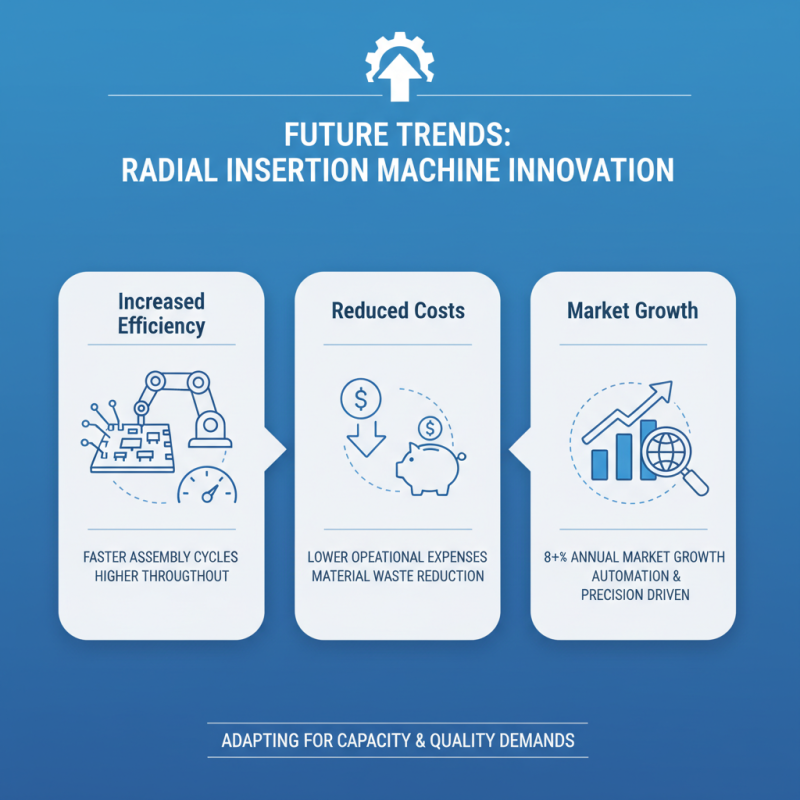
Radial insertion machines have seen significant advancements, focusing on improved efficiency and reduced operational costs. According to a recent industry report, the global market for these machines is expected to grow by over 8% annually. This growth emphasizes the urgent need for manufacturers to innovate and adapt. Changes are necessary to meet capacity demands and quality standards, reflecting a shift toward automation and precision engineering.
Future trends point to the integration of AI and machine learning in radial insertion systems. Data suggests that automated systems can decrease production errors by up to 30%. Maintaining software updates and real-time monitoring encourages higher accuracy and operational speed. However, the challenges here include the initial investment and training required for staff. Many businesses find it challenging to balance advanced technologies with traditional methods.
Sustainability is another critical area of focus. The move towards eco-friendly solutions poses unique challenges for manufacturers. While there is a push for greener materials and more efficient energy use, the transition may take time. Reports indicate that the shift to sustainable practices can reduce material waste by as much as 50%. Yet, companies must evaluate the practicality of these changes within their existing setups. Continuous assessment and adaptation of these innovations will be essential for long-term success in radial insertion machine production.